A few days on from a brand new episode of Doctor Who, I present an alternative review to Revolution of the Daleks. Buckle up. This may get ugly.
2020 has been a tough year for so many people. A global pandemic. Lockdowns. An ever-increasing death toll as a result of coronavirus. Doctor Who should provide a distraction. An escape from the world around us for 75 minutes. Revolution of the Daleks should’ve promised an exciting adventure with one of the programme’s most popular creations. Instead, we were presented with a plotline which saw a politician triumphantly present new ‘defence drones’ outside 10 Downing Street. Drones which looked suspiciously like Daleks. We all knew where this was headed…
Defence Drones
The opening salvo of this episode began with the events of Resolution (of the Daleks) broadcast two years ago. Following a coincidental stop at the wrong roadside snackbar, the reconnaissance Dalek goes missing. Some time later curiously familiar Defence Drones are tested in front of a politician in a mock protest. In fairness this has been a year where violent protest has seemingly been on the increase. I for instance have watched in horror and disbelief as the UK Government has mishandled the Coronavirus pandemic and failed to protect the lives of its citizens. Now, my favourite TV show has sought to remind us of the possibility that we are all vulnerable to terrible consequences at the hands of incompetent politicians. I don’t need to watch that. We are living it!

We’ve seen a lot of politicians stood at podiums in 2020. I could also see the Prime Minister, a Home Secretary, or similar individual introduces us to something as ridiculous as defence drones that turn out to be deadly and capable of eradicating life. If someone went to a member of the current cabinet with one of these creations and explained how they could distribute the coronavirus vaccines then they’d be rolled out immediately! This plot towed close to the line of terrifyingly plausible. Ultimately, ‘Revolution of the Daleks‘ is a victim of fate. Recorded months ago, few could’ve predicted what would transpire after the episode was filmed. But given the current situation it failed to provide the escapism we all so desperately crave and was a horrible reminder of reality.
Return of the Yank
To support the narrative that we shouldn’t trust those in positions of power was the return of Chris Noth as Jack Robertson. Remember him from ‘Arachnids in the UK‘? A billionaire hotelier with aspirations of running for President of the United States of America. The blindingly obvious homage to Donald Trump. I hoped that my expectations would be subverted and Robertson was actually trying to warn people that these new defence drones were actually dangerous. Nope. It was as I anticipated. He’s responsible for the defence drones. If only he hadn’t been allowed to get away with that environmental disaster the last time we saw him!

His appearance was also a reminder of ‘Arachnids in the UK‘ which saw massive spiders simply left trapped in a Sheffield flat and the villain of the piece allowed to walk off into the sunset with no repercussions whatsoever. As a result of that inaction he acquires the Reconnaissance Dalek and, with the help of Nathan Stewart-Jarrett as Leo Rugazzi, a technical expert who can also clone biological cells, brings the defence drones into existence. Cue chaos, disaster and death although astonishingly it is Leo who brings it about because of his hubris. Remember kids, be wary of politicians, rich people and intelligent experts. Can’t trust any of them!
The Timeless Children Hangover
Now let’s deal with the elephant in the room. Unfortunately, the previous episode of Doctor Who was ‘The Timeless Children‘. Like so many others, I was far from enamoured by the conclusion to Series 12. The cannon busting revelations can and have been discussed at length elsewhere. However, it was the largely unsatisfying finale which left such a sour taste in the mouth. The Doctor was passive throughout and even in the final critical moments the decisive action had to be taken by notable guest star from Game of Thrones. Some things don’t change as The Doctor languishes in her cell. Good job Capt. Jack was back in this episode or she might still been stuck in that space prison!

Unsurprisingly it didn’t take long before the Doctor was able to escape. A few scenes with lots of lines on the walls failed to convince that the Doctor had been in there for a long time. On the plus side there were some nice monster cameos. The Silence were good weren’t they! Anyway, it would’ve been a truly unpredictable direction for ‘Revolution of the Daleks‘ to end with the Doctor right where she started the episode. Series 13 could then be incredibly bold and see Yaz and Capt. Jack unite to try and find the Doctor. But no the incarceration was largely meaningless, serving only to give Ryan time to decide to stay on Earth, and instead it was Capt. Jack to the rescue.
Capt. Jack saves the Doctor and the episode
The return of John Barrowman as Capt. Jack Harkness was a major selling point to actually watching this episode. For some it may be that his return was the only reason they watched ‘Revolution of the Daleks‘. His cameo in ‘Fugitive of the Judoon’ was pointless, serving only to distract the rest of the Fam whilst the Doctor encountered the Fugitive Doctor. This appearance was fortunately much more significant. Barrowman‘s charisma and enthusiasm for the role is always an entertaining watch. But he was more than that. Capt. Jack was the driving force for the action, breaking the Doctor out of space prison, investigating the Osaka Dalek mutant farm, infiltrating the Dalek ship and detonating the bombs on board. By comparison what did the Doctor do?

Remember when the Tenth Doctor punished the Family of Blood in that dramatic sequence at the end of that Series 3 two-parter? That was a good time. Unfortunately, the Thirteenth Doctor remains painfully passive. The action appears to just occur around her. She had verbal exchanges with Jack Robertson and Leo Rugazzi. Summoned the Daleks then taunted them from the TARDIS doors. Finally she gave out some hugs to the fam. The last one was of course vitally important.
Farewell to the Fam
Now where to start with ‘the Fam’. For so long we have bemoaned the fact that three companions is too many. With not enough time to delve into their characters, they’ve become a trio of largely bland scene fillers. In this episode we had Yaz sleeping in the borrowed TARDIS, trying to work out how to find the Doctor again. She came across like an ex who just can’t quite get over the breakup. She came across better when she did nothing. The ironic thing was that Yaz had the audacity to criticise Jack for needing praise! She’s the most needy character in Doctor Who we’ve ever seen! But fear not, John Bishop is joining the team because why return to the successful formula of Doctor plus one companion. This is because two spots have now opened up in the TARDIS.

The poor characterisation of the constituent parts of ‘the Fam’ made the break up severely lacking in emotion. What didn’t help was that despite a 75 minute running time both Ryan and Graham were again given little to do. Tosin Cole did share a dreary scene with Jodie Whittaker which dragged on and allowed Chris Chibnall to patronise the sections of fandom offended by his mutilation of the established cannon. By comparison Bradley Walsh and Graham seemed to be an after thought. This was epitomised by their departure scene where Ryan decides to leave so Graham decides to as well. It was almost fitting that we ended up back on the grassy hillside with Ryan attempting to overcome his dyspraxia because that first episode was probably the last time this interesting character point was actually mentioned.
The Chibnall Era
‘Revolution of the Daleks‘ proved to be a reminder of all the problems with this current era of Doctor Who. Firstly, it failed as entertaining escapism. Instead of lecturing us that mankind is slowly destroying the planet or that plastic is bad, we were taught that we shouldn’t trust politicians, technical experts or American businessmen. Speaking of that American businessman, the lack of any repercussions and villains being allowed to simply exit stage left proved catastrophic. But don’t worry it only happened TWICE during this episode as well. Meanwhile, the Doctor, our lead character and supposed hero, offered nothing other than exposition. Oh and hugs for the fam but the less said about them the better.

I’m sure the irony wasn’t lost on some as the RTD-era bronze Daleks obliterated the inferior Chibnall-era creations. I was frankly astonished that the television show itself would highlight in such obvious terms that the current era is so clearly worse than what has gone before. The ‘defence drones’ looked so flimsy opposite the bronze tanks from 2005. Similarly, the scenes in the space prison reminded you how great monsters like the Ood and Sycorax were before making you recall how rubbish the Pting was. Chibnall’s speech, sorry Ryan’s speech, concerning change would be far more effective if the rest of the episode didn’t highlight all it’s own flaws.
Conclusion
Summarising ‘Revolution of the Daleks‘ is fairly simple. It wasn’t as bad as ‘Arachnids in the UK‘ or the utterly abysmal ‘Orphan 55‘. Nor was it as deliberately offensive to long-term fans as ‘The Timeless Children‘. Instead it was a bland, predictable and ultimately underwhelming episode of Doctor Who. At least the next series will only have eight episodes to endure!
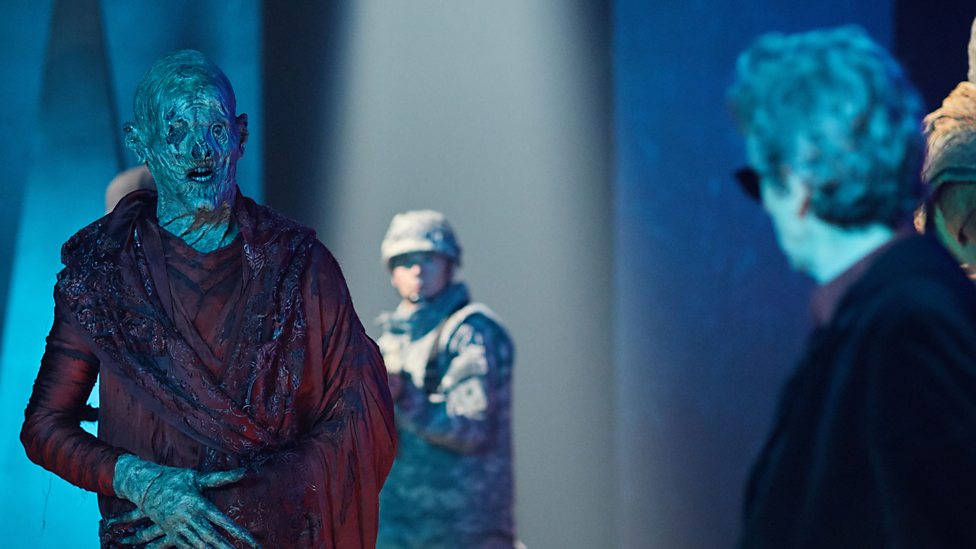


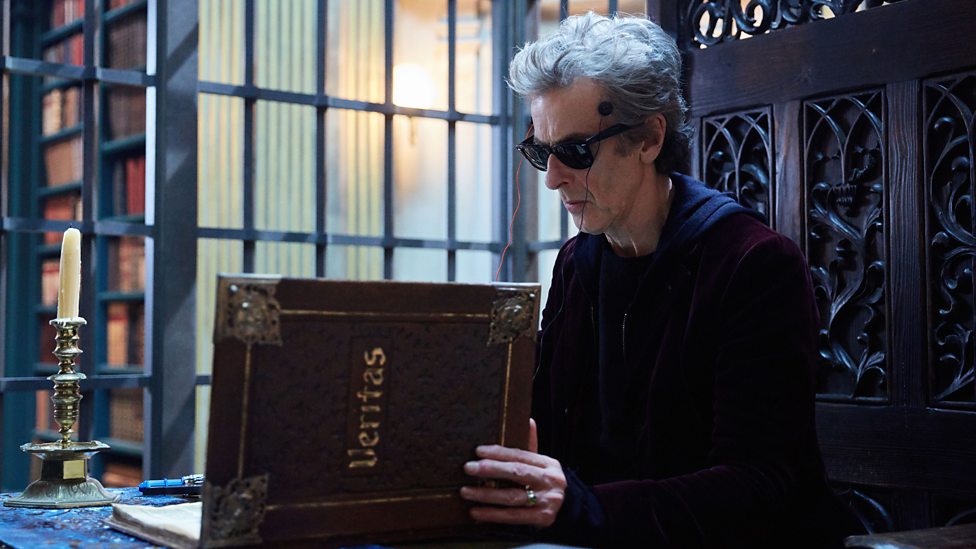 It has been a few days since I watched Doctor Who ‘Extremis’. On first viewing I was gripped and thoroughly engrossed with what was presented. However, the more I’ve thought about it, the more the episode falls apart…

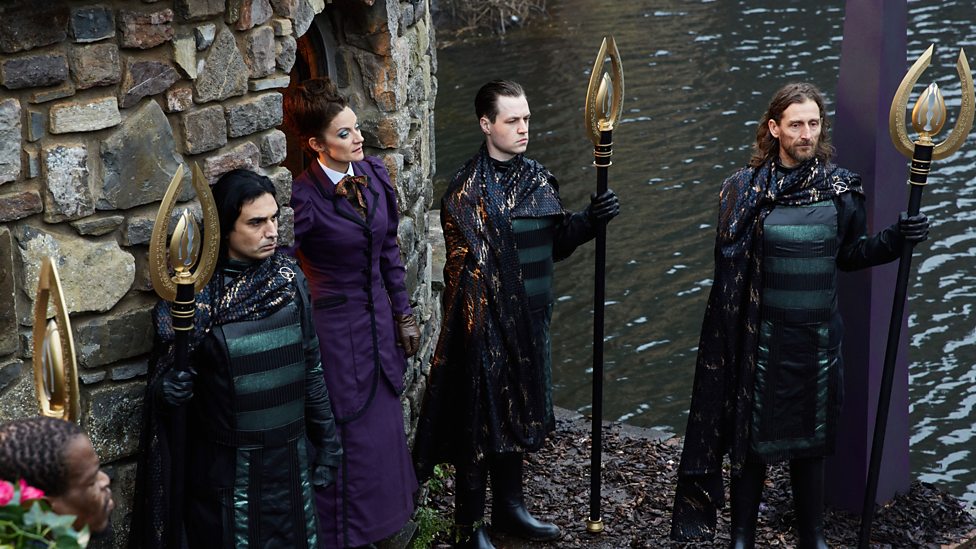 Missy
Missy Steven Moffat : The Legend
 Chris Chibnall
 The Future
 The series finale of Doctor Who is one of the highlights of the year but so often fails to match the hype, could ‘Hell Bent’ buck the trend? Sadly not. After the superb effort of last week’s episode the viewer is brought down with a crushing bump. In ‘Heaven Sent’ the Doctor struggles to deal with the loss of Clara, angry, alone and afraid. But it’s okay because this week he has found her again, almost immediately, in an American diner of all places. So what was the point I hear you cry? Who knows!
  The companion is a crucial part of Doctor Who and why it is successful. They are the human, more often than not, that the viewer can connect with and journey with vicariously. By contrast the Doctor is an alien and so difficult for us to relate with. This has been the case since the beginning when the old man in a junkyard was a complete mystery and two school teachers provided audience connection. However, when the show becomes all about the companion it sidelines the Doctor, your leading man, belittling the programme to the level of generic serial drama (soap opera).
 Clara Oswald is the absolute worst culprit for this. She became the impossible girl, splintered along the Doctor’s timeline to save him over and over again. She triggered the Doctors’ change of plan and the ultimate rescue of Gallifrey. In ‘Listen’ (2014) she cements herself as the reason why a young Timelord had a fear of the dark. A year ago the series finale became the story of heartbreaking loss of boyfriend Danny, suffocating an exciting Master/Cyberman storyline into an irrelevant sideshow. History has repeated itself with that one. She has been the villain through Zygon doppelganger Bonnie and has become the Doctor, Jenna Coleman’s face even appeared in the title sequence for Death in Heaven, as sacrilegious as you can get. Now the character even has herself a TARDIS! The lunacy of a woman who apparently couldn’t work iplayer or wifi now being able to pilot a time machine is unfathomable. Friends are those who leave footprints on our lives, Clara Oswald has left a steaming turd.
 As has been the trend with the whole series there was no big action set pieces just dialogue heavy acting lessons. Last we knew of Gallifrey it had been placed in a parallel pocket universe, however at the end of all things it magically reappears in it’s original universe so the Sisterhood of Karn can pop by. Explaining that away is conveniently passed over. However, Gallifrey looked incredible and there was even a new old TARDIS to get gooey eyed about. Rassilon was overthrown. There were nice cameos from a Dalek, Cyberman and Weeping Angel, just because. We even had a returning Maisie Williams, again just because. Who even knows what the hybrid was, apart from a plot point, so sadly no new fantastically brought to life creature. Just a prophecy that delivers only more words. The elements were all there including Peter Capaldi at the absolute height of his acting skills but sadly nothing but a flat aftertaste is delivered. At least he finally has his own sonic screwdriver, only taken 2 years!
 I’ve decided to revisit some of the lost episodes from Doctor Who’s history which no longer exist in the archives by using the original audio recordings which have been remastered and released onto CD. It is also possible to find some very good reconstructions on the internet using images taken from the broadcast.
 After the travellers return to the TARDIS and leave they take a pause to celebrate, despite being in the midst of an epic battle with the Daleks, toasting a happy Christmas with some champagne. The Doctor turns to the camera and wishes “a happy Christmas to all of you at home”, breaking the fourth wall and addressing the audience directly, the only time in the programme’s history that this has been done.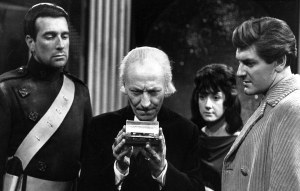
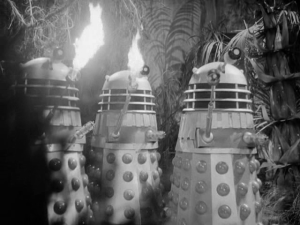 A particular highlight is the scene of the Daleks burning down the forest of Kembel, there is something very beautiful about a Dalek with a flame thrower, even in black and white, and it surprises me that it has not been replicated more frequently.
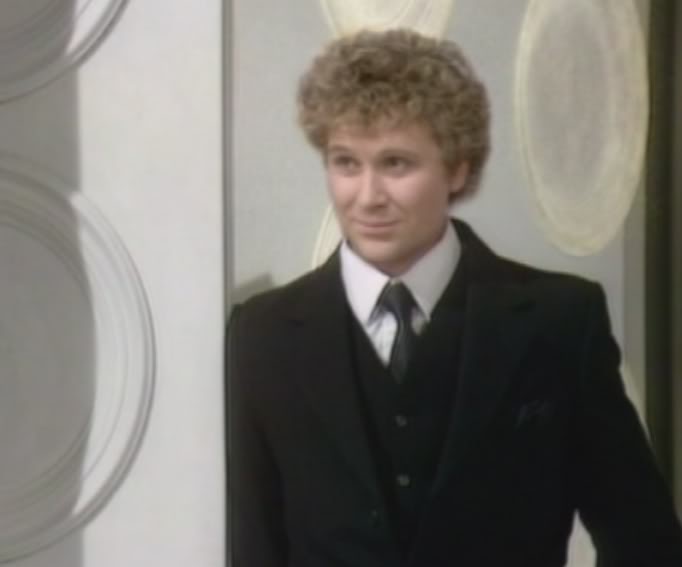
 Following on from Doctor Who Magazine’s interview with Colin Baker I have my own musings on his Doctor and in fact feel that he is without doubt the most hard done by actor to ever play the role. Colin makes valid points concerning his reluctance to talk to DWM. Most Doctor Who fans often feel a need to quantify everything concerning the show, I too am guilty of this, regularly typified by DWM who carry out votes asking readers to rate Doctors, stories and merchandise for example. The problem with this is that everyone has different opinions. In the same issue of DWM as Colin’s interview is the result of their 2014 series survey. The best episode as voted by the readers of DWM from Peter Capaldi’s first year in the role was ‘Mummy on the Orient Express’. Now although I enjoyed the story I personally didn’t think much of it, the resolution was particularly poor, in my opinion, considering it to be a case of style over substance. However, credit where it is due the Foretold/Mummy was superbly realised and skilfully portrayed. I personally thought ‘Listen’ was by far and away the highlight of the series but that is only my opinion and apparently does not correlate with the opinions of the majority. The problem therefore with having votes of this nature means that for all the celebrated ‘favourites’ you have those at the bottom end of the scale. It is therefore no wonder that Colin Baker was left deflated when his Doctor was rated towards the bottom as is his debut story ‘The Twin Dilemma’.
 There is no hiding from the fact that ‘The Twin Dilemma’ is poor, which is expected given the problems the production team had experienced with the script. For example, the twins are terrible. In their opening scene they speak very derogatory of their mother, immediately making them unlikeable and made worse when we discover they are mathematical geniuses. Boy geniuses in science fiction never appeal to the audience, modern US comedies yes, but not in science fiction. The costume design is also appalling, for example Kevin McNally’s character has a particularly garish multi-coloured top at one point and even Nicola Bryant’s costume looks like it has been thrown together. Mestor the gastropod is not brilliant either and the Jacondan’s do look like they have simply had feathers stuck to their heads.
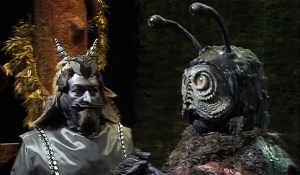 ‘The Twin Dilemma’ is one of the rare occasions where a new Doctor’s debut story is not the opener to a new season. In fact the only time this ever occurred before or since was with Patrick Troughton’s debut story, ‘The Power of the Daleks’. That decision was made to start the Sixth Doctor’s tenure with the final story of season 21, producer John Nathan-Turner feeling that “nine months was too long to wait to see the new guy”. This is the first decision which conspired against Colin Baker and sadly not the last. It was also decided that the regeneration process was to have a damaging effect and leave him disturbed. Following on from the previous incarnation this approach makes a lot of sense. However, this strategy doesn’t have the opportunity to be followed through properly. As a result you have a character that is a stark contrast to anything seen previously and as a result is deliberately unlikeable. The problem with that is the lengthy gap from March 1984 to January 1985 works against you. After that 9 month break the recollections of the viewer were of a character that is unpredictable and egotistical making it a difficult sell to get those people to engage with the programme again. Sadly the Sixth Doctor is often associated with strangling his companion and that remains a tough memory to break. But credit to the production team the lure of the Cybermen brought the viewers back and the remainder of Season 22 resulted in reasonably consistent viewing figures between 8 and 6.5million.

 Bedwyr Gullidge